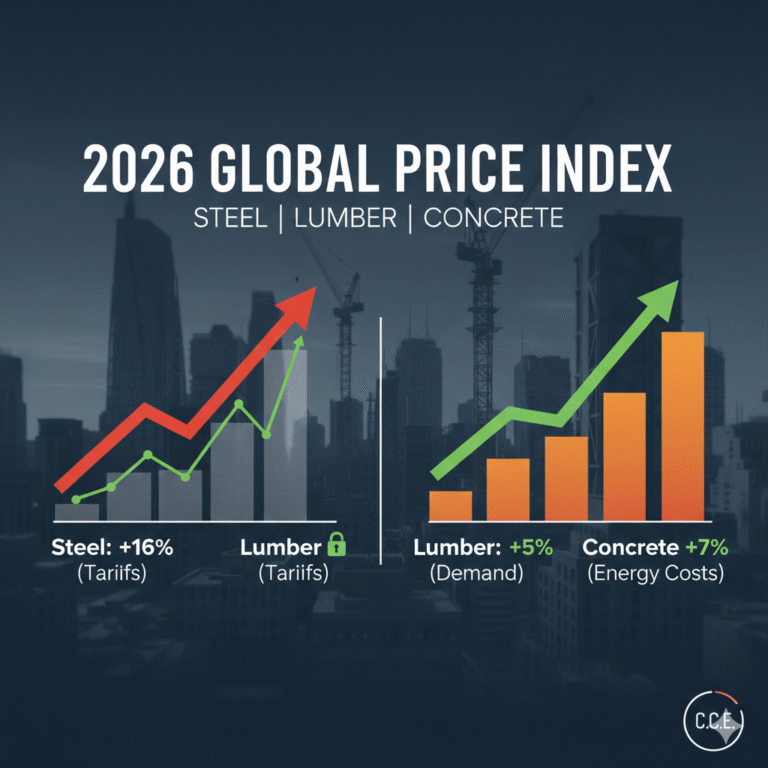
The journey from a complex set of architectural drawings to a winning bid is often the most stressful phase of a construction project. In the 2026 market, the margin for error has shrunk. Contractors in the USA, UK, and Canada are no longer just fighting against competitors; they are navigating extreme material price volatility and a highly scrutinized lending environment.

The professional workflow is the only safeguard against “the winner’s curse” winning a contract only to realize the project will lose money. Transforming blueprints into a precise financial plan requires a disciplined, step-by-step methodology that balances technical measurement with real-world market intelligence.
Phase 1: The Initial Project Scan and Feasibility Review
Before a single measurement is taken, an estimator must perform a deep-dive review of the bid package. This includes not just the architectural blueprints, but the structural notes, MEP (Mechanical, Electrical, and Plumbing) specifications, and the often-overlooked “General Conditions.” This initial scan identifies “deal breakers” such as unrealistic timelines or high-risk site conditions.
Understanding the project scope at this high level allows the team to decide if the project aligns with their current capacity. If the specs call for specialized materials with six-month lead times that the client hasn’t accounted for, that risk must be highlighted immediately. This early scrutiny is the hallmark of professional [suspicious link removed] and saves hundreds of hours in wasted effort on mismatched bids.
Phase 2: Technical Quantity Takeoffs and Digital Measurements
Once the project is greenlit for bidding, the technical work begins. The quantity takeoff is the process of quantifying every physical element required for the build. In 2026, manual scaling with a ruler is obsolete. Modern workflows utilize advanced digital takeoff software to “pull” measurements directly from 2D PDFs or 3D BIM models.

This phase is about volume, area, and count. The estimator determines the cubic yards of concrete, the tonnage of structural steel, and the linear footage of copper piping. These quantities form the raw data that will later be married to unit prices. Accuracy here is paramount, as a 5% error in concrete volume on a high-rise project can equate to tens of thousands of dollars in unrecovered costs.
Phase 3: Applying Unit Costs and Regional Labor Rates
With a complete list of quantities, the estimator must now apply the “price.” This is where regional expertise becomes critical. A square foot of drywall in New York City carries a vastly different cost than the same square foot in a rural Canadian province due to labor union rates, transport logistics, and local taxes.
Professional estimators often refer to The Definitive Guide to Construction Cost Estimating in 2026 to ensure they are using the correct escalation factors for the current year. They don’t just rely on historical data; they call suppliers and subcontractors to get “real-time” quotes. This prevents the bid from being based on outdated figures that don’t reflect the current 2026 supply chain reality.
| Workflow Step | Primary Focus | Output Document |
| Project Scan | Risk & Feasibility | Go/No-Go Decision |
| Digital Takeoff | Material Quantities | Bill of Quantities (BOQ) |
| Costing | Unit Rates & Labor | Draft Estimate |
| Final Review | Markups & Risk | Final Bid Proposal |
Phase 4: Indirect Costs and Site-Specific Logistics
A common mistake is focusing solely on the “bricks and sticks” while ignoring the cost of actually running the job site. Indirect costs often called “preliminaries” in the UK include site trailers, temporary power, cranes, scaffolding, and project management salaries. These costs are time-dependent; the longer the project takes, the higher these expenses climb.
Logistics can make or break a bid in 2026. If a project is located in a congested urban center, the estimator must account for traffic control, nighttime delivery premiums, and limited storage space. These “hidden” costs are often the reason why inexperienced bidders find themselves in financial trouble halfway through a project.
Phase 5: Risk Assessment and Final Bid Harmonization
The final step is the most subjective: the risk and profit review. This is where senior leadership reviews the draft estimate to decide on the appropriate markup. They look at the “contingency” fund, a percentage of the budget set aside for the “unknowns” like bad weather or unforeseen soil conditions.
Harmonization involves checking that all subcontractor quotes are “apples-to-apples.” If one mechanical contractor included the HVAC controls and another didn’t, the estimator must normalize those bids. Once the risks are mitigated and the profit margin is set, the final proposal is packaged and submitted. A Construction Cost Estimating (C.C.E) professional bid isn’t just a number; it is a clear, transparent document that shows the client exactly what they are paying for and what is excluded.
Frequently Asked Questions
Why is the project scan phase so important?
It identifies risks before you spend money on a detailed estimate. If the project has legal or logistical issues you can’t solve, it’s better to skip the bid than to win a losing contract.
How does digital takeoff software improve accuracy?
Digital tools eliminate human scaling errors and allow for “overlays,” where the estimator can compare two versions of a drawing to see exactly what changed in the design.
What is the difference between direct and indirect costs?
Direct costs are physical materials and labor on the building. Indirect costs are the “support” items like permits, site security, and trailers that don’t stay when the building is finished.
How do you handle material price spikes in 2026?
We use escalation clauses in bids and verify prices with suppliers at the last possible moment before submission to ensure the numbers are current.
What is a “Bill of Quantities” (BOQ)?
A BOQ is a detailed list of every material, part, and labor requirement for a project. It serves as the foundation for the final price and a guide for purchasing later.
How much profit should be included in a bid?
This varies by project size and risk, but most contractors aim for a net profit of 5% to 10% after all overheads are covered, though complex specialty trades may be higher.