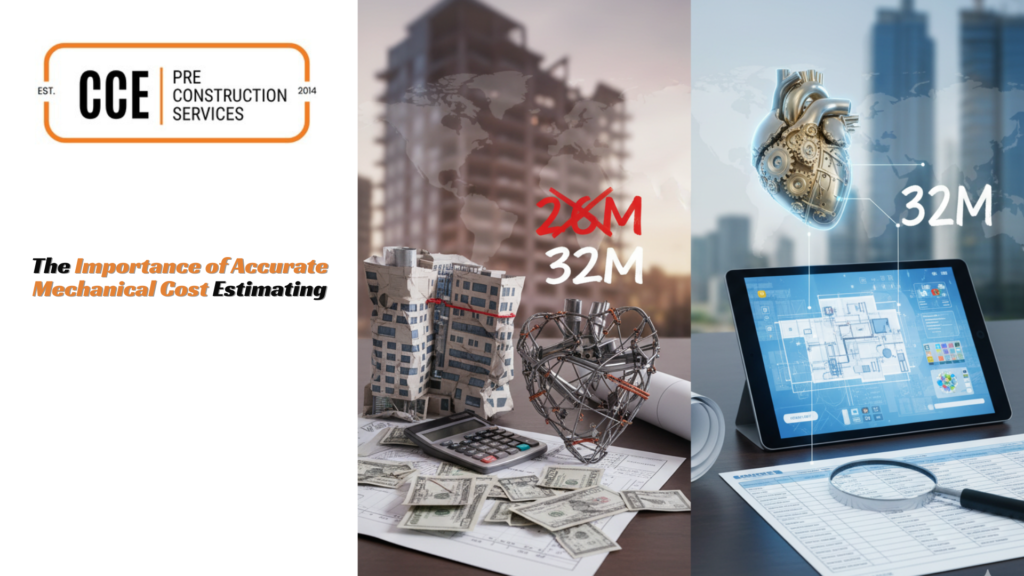
In 2015, a state-of-the-art hospital project in Houston faced an unexpected disaster. The mechanical estimates specifically HVAC duct routing and fire protection costs were off by 18%. What began as a $26 million budget spiraled into $32 million. The culprit wasn’t material shortage or labor inflation. It was the absence of accurate mechanical cost estimating a detail overlooked in the early planning phase.
This real-world incident isn’t isolated. Across the U.S., U.K., and Canada, mechanical systems HVAC, plumbing, and fire protection account for 35–45% of total construction costs in commercial buildings. When those estimates are inaccurate, entire schedules, safety systems, and budgets collapse.
That’s where Construction Cost Estimation Service (C.C.E) brings value. Our firm doesn’t just calculate numbers, we interpret blueprints, assess regional cost indexes, evaluate risk factors, and deliver mechanical estimating services that ensure every valve, duct, and fitting aligns with project goals.In construction, mechanical estimating isn’t optional; it’s the heartbeat of precision, efficiency, and profitability.
Why Mechanical Cost Estimating Matters in Modern Construction
Mechanical systems control air, water, fire protection, and environmental comfort. They’re invisible when done right and disastrous when done wrong. A poor mechanical estimate leads to rework, delays, and even code violations.
In the modern era, mechanical estimating services are far beyond pen-and-paper exercises. They use mechanical estimating software, data analytics, and historical cost databases to determine the mechanic labor cost, mechanic repair estimate, and complete system budgets for both commercial and residential projects.
When managed properly, these estimates ensure the project runs smoothly, avoids overspending, and meets sustainability goals. In fact, accurate mechanical cost estimation can reduce waste by up to 15% and cut rework expenses by 25%.
Historical Perspective From Steam Pipes to Smart Systems
Mechanical cost estimating has evolved alongside civilization. Ancient Roman engineers estimated aqueduct flow and material volumes without digital tools. By the Industrial Revolution, mechanical design involved complex steam networks, requiring labor-intensive estimation using manual tables.
Today, mechanical systems are digitally simulated before installation. From HVAC load estimation to fire suppression network costing, modern mechanical estimating software ensures precision across thousands of variables.
The transformation from paper drawings to BIM (Building Information Modeling) has allowed experts like C.C.E to integrate mechanical estimating services with 3D modeling, resulting in nearly zero rework and complete material transparency.
Key Components of Accurate Mechanical Cost Estimation
Accuracy starts with understanding what’s being measured. Whether it’s HVAC, plumbing, or fire protection, each system has its unique pricing structure. The table below compares average mechanical system costs across various building types in the U.S.
| Mechanical System | Residential Projects (USD) | Commercial Projects (USD) | Cost Driver |
| HVAC (Heating & Cooling) | $4,500 – $8,000 | $25,000 – $90,000 | Equipment Type, Size |
| Plumbing System | $2,000 – $5,500 | $15,000 – $70,000 | Fixture Count, Water Pressure |
| Fire Protection | $3,000 – $9,000 | $25,000 – $120,000 | Code Compliance |
| Duct Fabrication | $1,200 – $3,000 | $8,000 – $30,000 | Material Type, Layout |
In the U.S. market, mechanical labor cost ranges from $60 to $120 per hour, while in the U.K., it typically ranges between £40 to £70 per hour. These costs directly affect your mechanic estimate or mechanical repair estimate accuracy.
Mechanical Estimating vs. Mechanic Estimates The Common Confusion
It’s common to confuse mechanic estimate (auto repair) with mechanical estimating (construction). In the automotive world, clients often ask: “Do mechanics charge for an estimate?” The answer depends on the shop; some offer free estimates, while others charge diagnostic fees.
However, in construction, mechanical estimating is an advanced engineering service that evaluates systems like HVAC, plumbing, and mechanical ductwork, providing a professional assessment of costs, labor, and materials.
When you search “can a mechanic charge more than the estimate” or “do mechanics give free estimates,” you’re inquiring about service cost variations. But in construction, each estimate involves engineering evaluation, system analysis, and compliance checks that require certified expertise something C.C.E has mastered.
The Role of Mechanical Estimating Software in Accuracy and Speed
Modern projects rely heavily on mechanical estimating software tools designed to minimize human error and maximize consistency. These programs automate calculations for pipe lengths, duct dimensions, and equipment costs while considering labor rates and material wastage.
Here’s how technology impacts real-world performance:
| Estimating Aspect | Manual Approach | Software-Based Approach |
| Time Efficiency | 2–3 Days | 2–3 Hours |
| Error Rate | 15–25% | Under 5% |
| Cost Tracking | Manual Log Sheets | Real-Time Database |
| Revision Handling | Difficult | Instant Updates |
At C.C.E, our estimators use advanced tools to ensure that every mechanical cost estimate or mechanical building estimate remains aligned with local market data. This is especially critical when projects expand across multiple states like California, Texas, or Florida where cost indexes differ drastically.
Regional Cost Variations U.S., U.K., and Canada
Mechanical system costs vary widely depending on regional labor laws, climate, and energy efficiency standards. Below is a comparison of regional average costs for mechanical works.
| Country | Average Labor Cost | Material Cost (per sq.ft.) | Project Complexity Factor |
| USA | $65 – $120/hr | $2.50 – $4.50 | High (Strict MEP Codes) |
| UK | £40 – £70/hr | £1.80 – £3.20 | Moderate |
| Canada | CA$75 – CA$130/hr | CA$2.60 – CA$4.90 | High |
Accurate regional assessment ensures your mechanical estimating services reflect true market conditions, not outdated averages. You can explore our service coverage area via Google Maps link.
Leveraging Professional Mechanical Estimating Services
Working with experts like Construction Cost Estimation Service (C.C.E) means access to decades of experience and advanced data modeling.
We don’t just produce numbers, we deliver accuracy built on real-world performance data and regional intelligence.
By integrating:
- Construction Cost Estimating
- Mechanical Estimating Services
- MEP Estimating Services
- How To Estimate Electrical Cost For New Construction
you get complete synergy across every mechanical and MEP system in your project.
Common Mistakes in Mechanical Cost Estimation and How to Avoid Them
Even experienced contractors can miss critical factors. The most common pitfalls include underestimating system capacity, ignoring maintenance access, or overlooking local codes. Each of these can escalate project costs by 10–20%.
A frequent issue involves misjudging equipment redundancy requirements in healthcare or data centers. Estimators who fail to account for backup chillers or secondary pumps often face major overruns later.The solution lies in multi-level review, a principle C.C.E enforces rigorously. Each estimate passes through senior estimators, ensuring accuracy before submission.
The Future of Mechanical Estimating AI, BIM, and Data Integration
Tomorrow’s mechanical estimating is predictive. Artificial Intelligence (AI) and 5D BIM models now allow real-time synchronization between designs and cost data. These tools don’t just estimate they forecast financial impacts of design changes instantly.
Smart estimators today use digital twins to simulate how a building “breathes.” Every duct, pipe, and valve is mapped virtually, ensuring no overlap, waste, or design conflict.At C.C.E, integrating BIM with mechanical estimating software helps our clients cut estimating time by 60% and eliminate field conflicts before construction begins.
Conclusion Why Accuracy Equals Profit

The margin between profit and loss often lies in a decimal point. An underestimated mechanical system can derail a multimillion-dollar project, while precise estimation drives confidence, compliance, and cost control.
Construction Cost Estimation Service (C.C.E) stands at the forefront of mechanical estimating services in the U.S., U.K., and Canada delivering precision built on experience, innovation, and integrity.When you want accuracy that lasts beyond blueprints, you need expertise that calculates not just cost but confidence.
Frequently Asked Questions (FAQs)
1. What Is Mechanical Cost Estimation In Construction?
Mechanical cost estimation involves calculating the cost of HVAC, plumbing, and fire protection systems in a building project. It ensures that all components ducts, pumps, chillers, valves, and piping are accurately quantified and priced before construction begins.
2. Why Is Accurate Mechanical Estimating Important For Large Projects?
Because mechanical systems account for nearly half of a building’s operational cost. Inaccurate estimates cause project delays, budget overruns, and potential code violations.
3. Do Mechanics Charge For An Estimate?
Auto mechanics sometimes charge diagnostic fees for inspections. In contrast, mechanical estimators in construction provide technical evaluations, code reviews, and material takeoffs that justify professional service costs.
4. How Much Does It Cost To Become A Mechanic?
In the U.S., attending a mechanic school costs around $10,000–$25,000, depending on specialization and location. Diesel or aircraft mechanic training can reach $35,000–$50,000.
5. How Is Mechanical Estimation Different From Auto Mechanic Cost Estimation?
Auto mechanic estimates deal with individual vehicle repairs, while mechanical cost estimation in construction handles large-scale systems such as HVAC, fire protection, and plumbing across entire buildings.