When we look back at early hospital constructions from the mid-1900s, the failures weren’t caused by weak structures, they were born from miscalculations. A notable example occurred in the 1960s in New York, where a new hospital’s MEP systems overran the budget by nearly 60%. Why? The takeoff teams had relied on basic quantity counting, completely overlooking the complexity of medical gas systems, infrastructure redundancies, and infection-control ventilation.

Hospitals are not like residential or commercial projects. Every outlet, every duct, every pipe carries life-saving potential or life-threatening risk if miscalculated.
That’s why modern Hospital Takeoff Services are not merely about counting materials; they are about risk mitigation, cost control, and patient safety compliance.
Today, with expert services like Construction Cost Estimation Service (C.C.E) providing specialized Hospitals Takeoff Services across the U.S., U.K., and Canada, precision and accountability have finally caught up to the mission-critical nature of healthcare construction.
The Criticality of Specialized MEP: Managing the 50% Factor
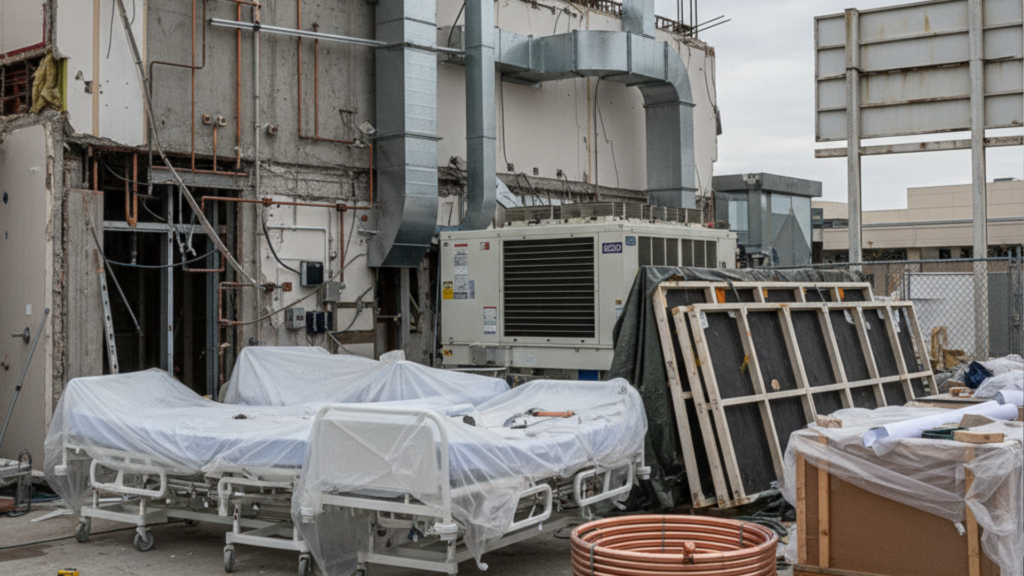
Hospital construction budgets typically dedicate 40–50% of total cost to MEP systems making accuracy in this domain non-negotiable. Each miscounted valve, duct, or wire can distort millions in budgets.
A. Medical Gas Systems The Lifeline Network
A hospital’s medical gas system is the bloodstream of its operations. Each floor requires oxygen, nitrous oxide, vacuum, and compressed air networks routed with strict zone isolation requirements.
A single missed Zone Valve Box or Alarm Panel can lead to both code violations and cost escalation.
| Component | Typical Unit Cost (USD) | Estimation Factor | Key Takeoff Detail |
| Zone Valve Box | $800 – $1,200 | Per room | Requires 1 per department zone |
| Alarm Panel | $1,200 – $2,000 | Per system | Installed near nurses’ stations |
| Source Equipment (Manifolds) | $3,000 – $5,500 | Each | Include spare line redundancy |
| Piping & Fittings | $5 – $9 /ft | Linear footage | Include fittings per code spacing |
Precise Medical Gas Piping Quantity and Source Equipment Takeoff from MEP drawings ensures compliance with NFPA 99 and avoids project delays.
B. Infection Control HVAC The Invisible Guardian
Every hospital’s HVAC system does more than cool or heat air; it controls infection flow.
Estimating for HEPA Filtration Units, Negative Pressure Rooms, and air change rates requires deep mechanical knowledge.
| Room Type | Air Change Rate (ACH) | HEPA Unit Cost (USD) | Special Material Considerations |
| Operating Theatre | 25–30 ACH | $2,000 – $3,200 | Anti-microbial duct coatings |
| ICU | 15–20 ACH | $1,500 – $2,700 | Airtight duct seals |
| Isolation Room | 12 ACH (Negative Pressure) | $2,800 – $4,000 | Special exhaust fans with HEPA return |
By applying OT HVAC Takeoff and Negative Pressure Room QTO accurately, estimators prevent scope gaps that often lead to HVAC redesign costs, one of the top five hospital construction overruns.
Mastering Code and Safety Compliance: The Hidden Cost Driver
Regulatory oversight for hospitals is rigorous. Materials like lead sheets, fire caulk, and smoke-rated barriers require not just count accuracy but also allowance accuracy accounting for waste due to overlaps, joints, and penetrations.
A. Radiation Shielding Precision Beyond Measurement
Radiation-controlled zones like X-ray or MRI suites require precise Lead Overlap Calculation to ensure shielding continuity.
| Material | Cost Per Sq. Ft. (USD) | Wastage Allowance | Notes |
| Lead Sheet (1/16″) | $6 – $10 | 8–12% | Includes 6-inch overlap per sheet |
| Lead Wool / Putty | $3 – $6 | 5–8% | Required at pipe & conduit penetrations |
| Lead Lined Door | $1,800 – $2,500 | N/A | Includes frame and hardware set |
Specialists at C.C.E ensure accurate Radiation Shielding Takeoff by including penetration sealants and wastage margins that untrained estimators often ignore.
B. Fire and Smoke Barriers The Invisible Compliance Line
The number of fire-rated doors, smoke partitions, and sealants in hospitals directly affects life-safety inspection approvals.
| Item | Estimated Cost (USD) | Estimation Factor | Purpose |
| Fire-Rated Door Assembly | $1,000 – $1,600 | Per door | Fire containment zone |
| Fire-Stopping Sealant | $12 – $20 /ft | Linear | Around all penetrations |
| Smoke Barrier Partition | $5 – $8 /sq. ft. | Surface area | For compartmentalization |
Precise Fire Stopping Material QTO ensures life-safety compliance and in many U.S. states, it’s a mandatory part of hospital building permits.
Leveraging Technology for Precision and Budget Control
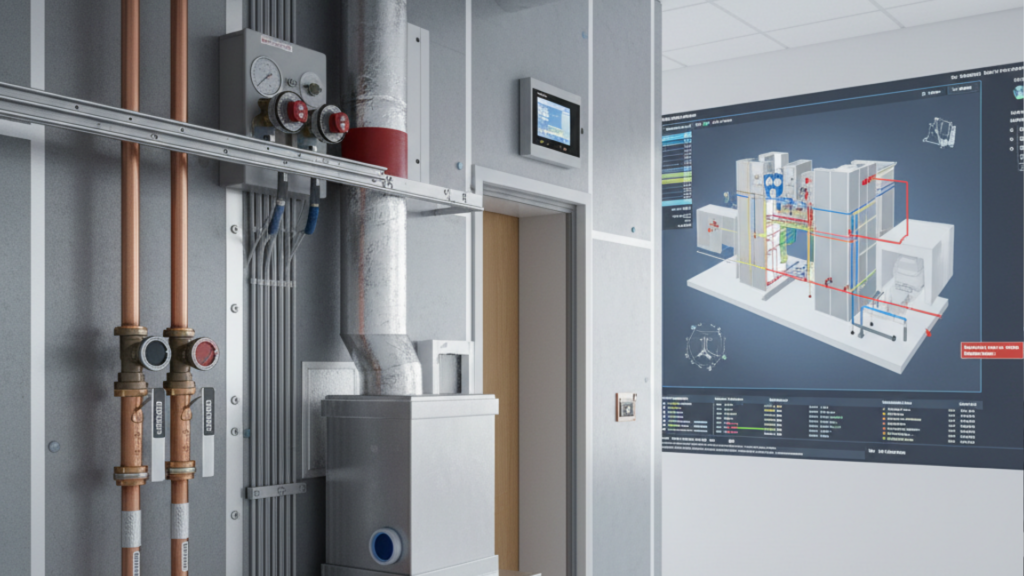
Inaccurate quantities lead to chaotic budgets. The best estimators now combine technology + human expertise to ensure every takeoff is clash-free and peer-reviewed.
A. BIM and 5D Estimating: Seeing Before Building
3D BIM models have transformed hospital takeoffs. Using Clash Detection in Takeoff, estimators can identify system conflicts before breaking ground preventing material waste and field errors.
| Benefit | Traditional QTO | BIM-Integrated QTO |
| Clash Detection | Manual, post-installation | Automated, pre-construction |
| Quantity Accuracy | ±10% margin | ±2% verified accuracy |
| Rework Costs | High | Minimal |
| Visualization | 2D drawings | Full 3D model |
Modern software used by Hospital Takeoff Services integrates cost, time, and resource management delivering a complete 5D Estimating output.
B. The Peer Review Mandate: Precision Through Accountability
Every major healthcare project handled by C.C.E undergoes a Senior Estimator Peer Review phase. This ensures MEP, radiation, and fireproofing quantities are double-checked for compliance before submission eliminating costly change orders later.
Regional Cost Variation: U.S., U.K., and Canada
Pricing structures for hospital construction materials vary by region.
| Region | Average MEP Cost (% of Project) | Labor Cost Index | Lead Sheet Cost/Sq. Ft. |
| United States | 45–50% | 1.0 (Base) | $6 – $10 |
| United Kingdom | 40–45% | 0.9 | £4.50 – £7.50 |
| Canada | 42–47% | 1.1 | CAD 8 – CAD 12 |
You can view the service coverage through this Google Maps link, which highlights C.C.E’s operating zones across the Pearl States and other healthcare development regions.
Why C.C.E Leads the Way in Hospital Estimating
Construction Cost Estimation Service (C.C.E) specializes in Construction Cost Estimating for healthcare projects covering hospitals, clinics, and labs. Their MEP Estimating Services combine years of data, code compliance expertise, and advanced modeling.
Whether for surgical suites, ICUs, or diagnostic wings, C.C.E ensures precision and transparency that directly supports project feasibility and compliance certification.
For more cost-saving guidance, explore How Accurate Quantity Takeoffs Can Boost Profits on Your Next Subdivision Project — another resource demonstrating how proper quantity takeoff methods lead to real-world project gains.
Frequently Asked Questions (FAQs)
How Do Hospital Takeoff Services Improve Construction Planning?
They prevent cost overruns by providing exact quantities for MEP, structural, and compliance materials leading to more accurate bids and reduced rework.
What Makes MEP Estimation Critical for Hospitals?
Because MEP can account for up to 50% of total costs. Accurate estimation ensures functionality and safety in critical medical zones.
How Does BIM Enhance Hospital Takeoffs?
By detecting system clashes before construction, saving both time and money while improving coordination among trades.
What Are Common Mistakes in Hospital Takeoffs?
Ignoring lead overlap allowances, underestimating HVAC duct sealing materials, and missing fire-stopping elements.
Can I Get Regional Cost Estimates for Hospital Projects?
Yes, C.C.E provides detailed regional pricing for the U.S., U.K., and Canada, based on real-time construction market data.