
Thousands of years ago, before computers or calculators, builders still had one question: “How much material will I need?”
From the Great Pyramids of Egypt to the Roman Colosseum, early engineers performed manual quantity takeoffs counting stone blocks, timber beams, and manpower by hand.

In ancient Egypt, scribes used reed pens on papyrus to calculate how many limestone blocks were required for each pyramid layer. Similarly, Roman builders estimated quantities for arches and aqueducts using simple geometry. These were the earliest forms of construction takeoff determining quantities before the first stone was laid.
Today, while technology has transformed the process, the core idea remains unchanged you still need to know how much material, time, and labor your project will require. That’s where Construction Cost Estimation Service (C.C.E) comes in combining ancient logic with modern precision.
What Is a Construction Takeoff?
The construction takeoff (also called a material takeoff or quantity takeoff) is the process of calculating and listing all the materials, labor, and costs required to complete a construction project.It’s like the foundation of your cost estimate everything else (budgeting, bids, and profit margins) depends on how accurate your takeoff is.
| Element | Purpose in a Takeoff | Example |
| Materials | Identify quantity and type needed | Concrete, lumber, steel |
| Labor | Estimate required workforce | Electrical, plumbing, framing |
| Equipment | Include machinery & tool costs | Excavators, cranes |
| Overheads | Add indirect project expenses | Permits, insurance, logistics |
When done right, a precise takeoff can prevent cost overruns, project delays, and material shortages ensuring every brick and beam fits both your design and your budget.
How Modern Estimators Work: From Blueprints to Precision
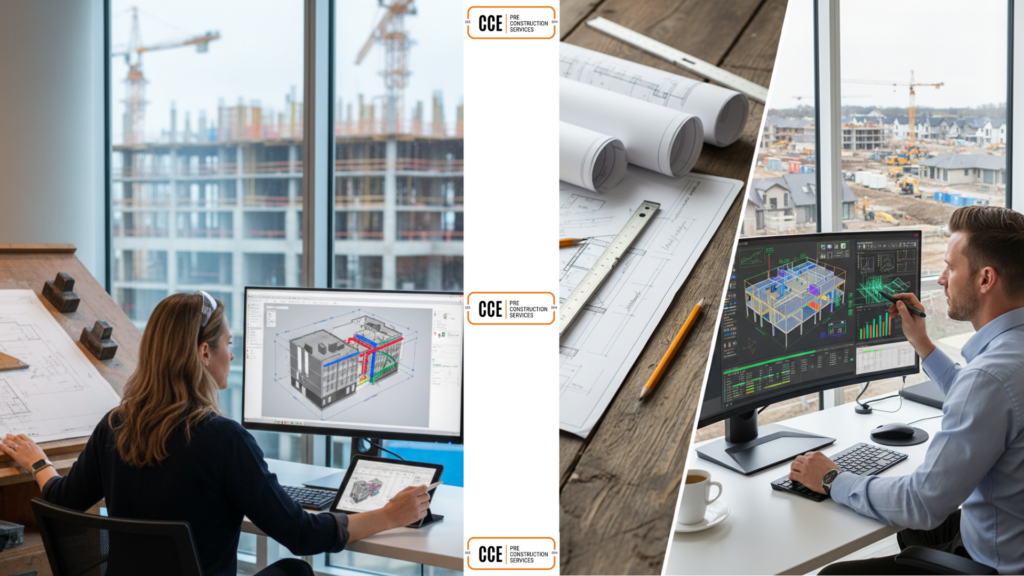
Back in the day, estimators used rulers and pencils over physical blueprints. Now, we use construction takeoff software like PlanSwift, Bluebeam Revu, and STACK. These programs allow estimators to digitally measure, annotate, and calculate areas, lengths, and volumes from 2D or 3D models.
| Stage | Old Method | Modern Digital Takeoff |
| Measurement | Manual with scale ruler | Automated through digital drawings |
| Data Entry | Written notes | Integrated into software |
| Revisions | Manual recalculation | Real-time update |
| Accuracy | Human error risk | ±1% digital precision |
Whether you’re using construction takeoff software, electrical takeoff services, or lumber takeoff services, digital tools now make takeoffs faster, more accurate, and easier to revise as designs evolve.
Why Construction Takeoff Services Matter More Than Ever
With construction costs rising across the U.S., U.K., and Canada, small miscalculations can lead to thousands in lost profit. The takeoff specialist doesn’t just count materials they ensure profitability.That’s why C.C.E. (Construction Cost Estimation Service) provides specialized construction takeoff services across multiple trades:
- Residential & commercial projects
- MEP (Mechanical, Electrical, Plumbing) systems
- Earthworks & roadwork
- Roofing, framing, and interiors
Accurate takeoffs help project managers make data-driven decisions before bidding or breaking ground. You can also explore our detailed Construction Takeoff Services to learn how professional estimators save both time and money.
zzHow to Perform Your First Construction Takeoff: Step-by-Step
Learning to estimate your first project can feel overwhelming but if you follow a systematic process, you’ll get accurate and reliable results.
| Step | Action | Tools/Notes |
| 1️⃣ Review Project Drawings | Understand blueprints thoroughly | Architectural & structural plans |
| 2️⃣ Highlight Work Sections | Identify walls, floors, fixtures | Use digital markup tools |
| 3️⃣ Measure Quantities | Take linear, area, or volume measures | Construction takeoff software |
| 4️⃣ Apply Unit Costs | Use local cost databases | RSMeans or C.C.E. rate sheets |
| 5️⃣ Include Labor Rates | Adjust for location & complexity | Labor cost estimator |
| 6️⃣ Add Overheads & Markups | Cover admin, risk, profit | 5–15% markup typical |
| 7️⃣ Review for Accuracy | Double-check data before submission | Peer or software review |
Each step may sound simple but precision and attention to detail are what separate a beginner estimator from a professional one.
Real-World Example: From Small Homes to Subdivision Projects
Let’s take a real scenario.
A single-family home in Michigan requires a complete material takeoff: concrete foundation, framing, roofing, and MEP systems.
A basic material takeoff might look like this:
| Category | Estimated Quantity | Unit Cost (USD) | Total Cost |
| Concrete | 80 cubic yards | $135 | $10,800 |
| Lumber | 18,000 board feet | $2.85 | $51,300 |
| Electrical | 2,200 sq ft wiring | $6 | $13,200 |
| Roofing | 3,000 sq ft shingles | $5 | $15,000 |
| Plumbing | 18 fixtures | $250 | $4,500 |
| Total | $94,800 |
Now imagine a subdivision project with 30 homes even a 2% takeoff error could lead to $50,000–$60,000 in loss.
That’s why professional quantity takeoff services are essential for large-scale developments.
Regional Expertise: U.S., U.K., and Canada
In regions like Florida, Texas, California, and Ontario, construction conditions differ.
From storm-resistant roofing to frost-proof foundations, every location demands localized cost understanding.
C.C.E. has specialized estimators who know how to adjust material pricing and labor rates based on regional standards, ensuring your estimates reflect real-world market costs.Check our service coverage areas on Google Maps.
How to Choose the Right Takeoff Estimating Services
Choosing the right takeoff partner means looking for accuracy, experience, and transparency.
Here’s how C.C.E. stands out among U.S. and Canadian competitors:
| Feature | Typical Service | C.C.E. Advantage |
| Accuracy | ±10% variation | ±2% verified precision |
| Delivery Time | 5–7 business days | 48–72 hours turnaround |
| Coverage | Limited trades | All major trades (MEP, Civil, Residential) |
| Format | PDF only | Excel + Editable Takeoff Sheet |
| Support | Email only | 24/7 Live Project Updates |
You can also explore Xactimate Estimating Services for insurance and restoration projects.