Most residential projects fail quietly before construction begins, not because of design choices or finishes, but because the initial cost planning is inaccurate. Many homeowners and builders rely on rough guesses or “per square foot” averages, which often ignore the true complexities of a build.
The Construction Cost Estimation Service (C.C.E), we focus on delivering measured, reliable, and transparent residential estimates. Each estimate is based on real quantities, material costs, labor, and local regulations. This ensures owners, builders, and investors understand exactly where the budget is allocated and what factors could impact cost.
To give you a clear, measurable quantity breakdown that protects your bid, your budget, and your reputation.
Risk Area | Common Issue | Impact on Project |
Miscalculated Materials | Ignoring elevators, garage doors, or HVAC upgrades | Budget shortfalls, delayed procurement, increased change orders |
Labor Misestimation | Not accounting for complex installations or overtime | Schedule delays, labor cost overruns, project stress |
Regional Code & Site Factors | Ignoring local code compliance or site conditions | Unplanned modifications, inspection failures, additional costs |
Hidden Scope Items | Electrical, plumbing, or structural elements missed in rough estimates | Last-minute changes, contractor disputes, financial risk |
Lack of Transparency | Estimates presented as “ballpark numbers” | Poor decision-making, loss of confidence from owners, banks, or investors |
Step | What We Do | Client Benefit |
Data Collection | Gather architectural drawings, MEP plans, and site details | Ensures every detail is captured from the start |
Detailed Takeoff | Measure all quantities: material counts, assemblies, areas, and labor hours | Clear understanding of exact resource needs |
Cost Mapping | Apply local material and labor rates | Accurate, region-specific budgets |
Quality Verification | Cross-check for missing items, hidden scope, and compliance with code | Reduces risk of surprises or cost overruns |
Transparent Reporting | Present structured tables and cost breakdowns for review | Owner, builder, and bank can confidently approve decisions |
Challenge | Generic Approach | C.C.E Solution |
Budget Accuracy | Relying on averages or rough estimates | Real measurement and pricing by room, system, and special item |
Timeline Planning | No insight on labor distribution or phasing | Structured estimate aligned with project schedule |
Upgrade Decisions | Guessing the cost of elevators, solar panels, or premium finishes | Detailed cost comparison for upgrades to make informed choices |
Investor/Bank Review | Ballpark numbers are rejected or questioned | Defensible, transparent cost breakdown ready for approval |
Residential estimating is the structured process of turning your drawings, specs, and site conditions into a complete, measurable, and explainable cost breakdown. Instead of bullets, let’s map the concept clearly:
Aspect | What It Means In Residential Estimating | Why It Matters For You |
Scope Definition | Listing every room, level, exterior element, system, and upgrade | Prevents “I thought that was included” conflicts |
Quantity Takeoff | Measuring areas, lengths, counts (walls, slabs, windows, fixtures) | Gives a measurable base for material and labor pricing |
Material Pricing | Linking measured quantities to current market rates | Reflects real-world cost, not old catalog numbers |
Labor Estimation | Calculating crew sizes, hours, and productivity rates | Avoids underpricing your contractor’s effort |
Allowances & Provisional Sums | Setting budget placeholders for unresolved selections | Keeps you flexible without hiding costs |
Risk & Contingency | Factoring in design changes, site conditions, and unknowns | Protects you against realistic surprises |
Timeline Impact | Linking costs to schedule (fast-track vs standard) | Shows how “faster” almost always means “more expensive” |
Residential construction estimating services give you clarity on what it really costs to build, remodel, or extend before you sign contracts or pour concrete.
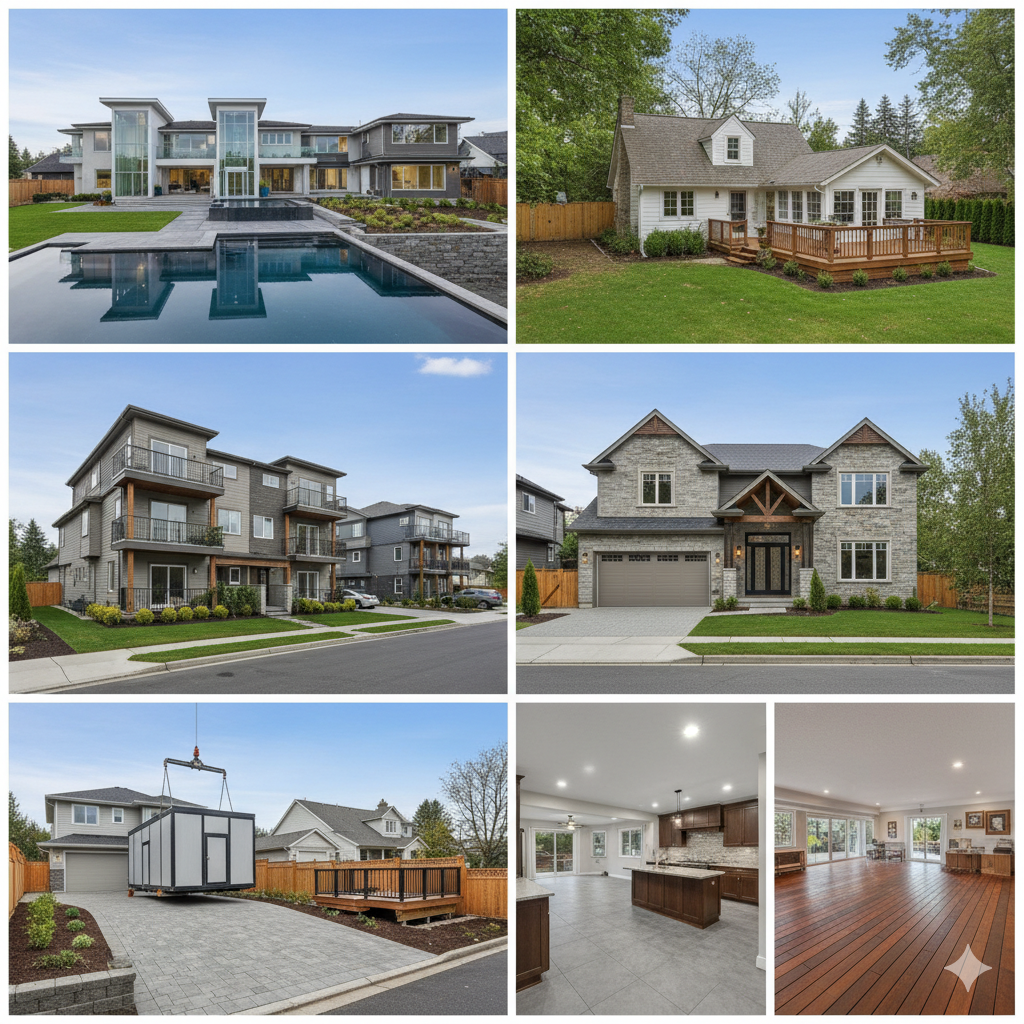
Residential work is not just “houses.” It includes many shapes, sizes, and complexity levels.
Residential Project Type | Examples | How C.C.E Handles The Estimate |
New Single-Family Homes | Custom homes, spec homes, countryside houses | Full takeoff: foundation, framing, finishes, MEP, sitework, allowances |
Multi-Family | Duplexes, townhomes, small apartment buildings | Unit-based costing with shared MEP + circulation logic |
Renovations & Remodels | Kitchen remodels, basement finishes, additions | Extra focus on demolition, unknown conditions, tie-in points |
High-End Custom | Luxury homes with elevators, pools, smart systems | Detailed breakdown of premiums: finishes, systems, specialty trades |
Accessory Units | ADUs, garage apartments, guest houses | Cost comparison: stick-built vs modular vs prefab |
Exterior & Site Works | Decks, driveways, landscaping, retaining walls | Separation of structural vs cosmetic to help with phasing |
For each category, our Residential Estimating Services are designed to match the real decisions you need to make not just to fill a spreadsheet.
People love asking, “What’s the cost per square foot?” It’s a useful reference, but also one of the weakest ways to actually plan a project. Here’s how we structure a residential estimate with real components:
Cost Component | What It Covers | Why It Can’t Be Ignored |
Structure | Foundation, framing, roof, slabs, beams | Handles the load; errors here are very expensive |
Enclosure | Walls, windows, doors, insulation, roofing finishes | Affects comfort, energy performance, and durability |
Interiors | Flooring, ceilings, cabinetry, wardrobes, finishes | The visible parts that often drive upgrades and overruns |
MEP Systems | Electrical, HVAC, plumbing, mechanical units | Life-safety and comfort; poor allowance leads to big surprises |
Site & Exterior | Driveways, patios, fences, landscaping, grading | Often underestimated but highly visible and costly |
Special Systems | Solar panels, elevators, home automation, special lighting | Premium items that need clear cost visibility |
Soft Costs | Permits, design fees, surveys, consultants | Critical spend that owners often forget to budget |
This is how we approach estimating residential construction costs: not by guessing a rate per square foot, but by building the estimate from the ground up.
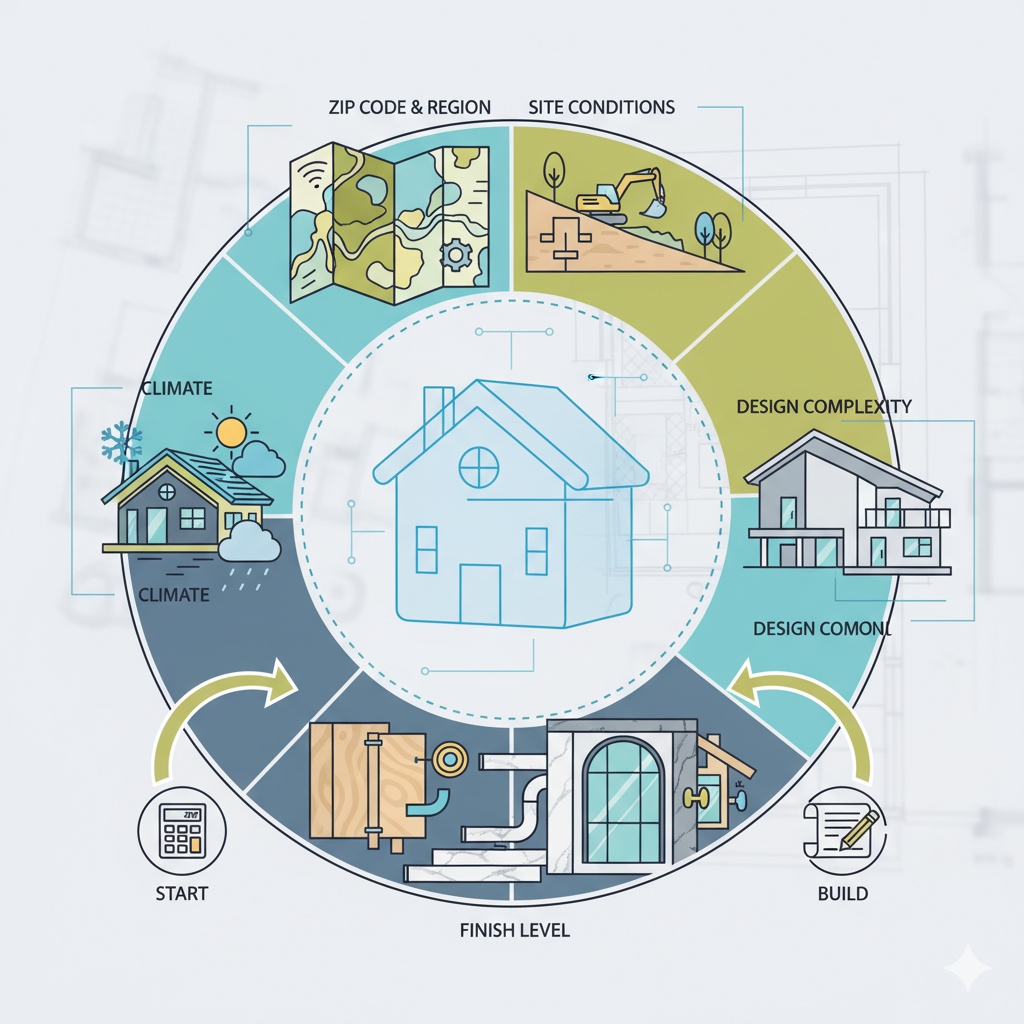
The residential construction cost per square foot by ZIP code calculator can be useful for quick comparison but it’s not enough for a serious decision.
We combine market-index tools with real estimating logic:
Factor | How It Affects Cost | Our Approach |
ZIP Code & Region | Labor rates, material access, logistics, regulations | Use indexed data + local adjustment factors |
Site Conditions | Sloped lot, soil conditions, access restrictions | Add cost for retaining walls, special foundations, logistics |
Climate | Snow loads, insulation, roof type, window spec | Adjust structure and envelope assumptions |
Design Complexity | Simple box vs many corners, roofs, cantilevers | Increase labor + waste factors for complex geometry |
Finish Level | Basic builder grade vs high-end custom | Create clear cost options at different finish standards |
So when a client asks, “How to do a residential cost estimate?” or
“How to estimate residential construction costs?”,
Our answer is: Start with zip-code-calibrated baselines, then build a line-by-line estimate from your drawings. Don’t stop at just a calculator.
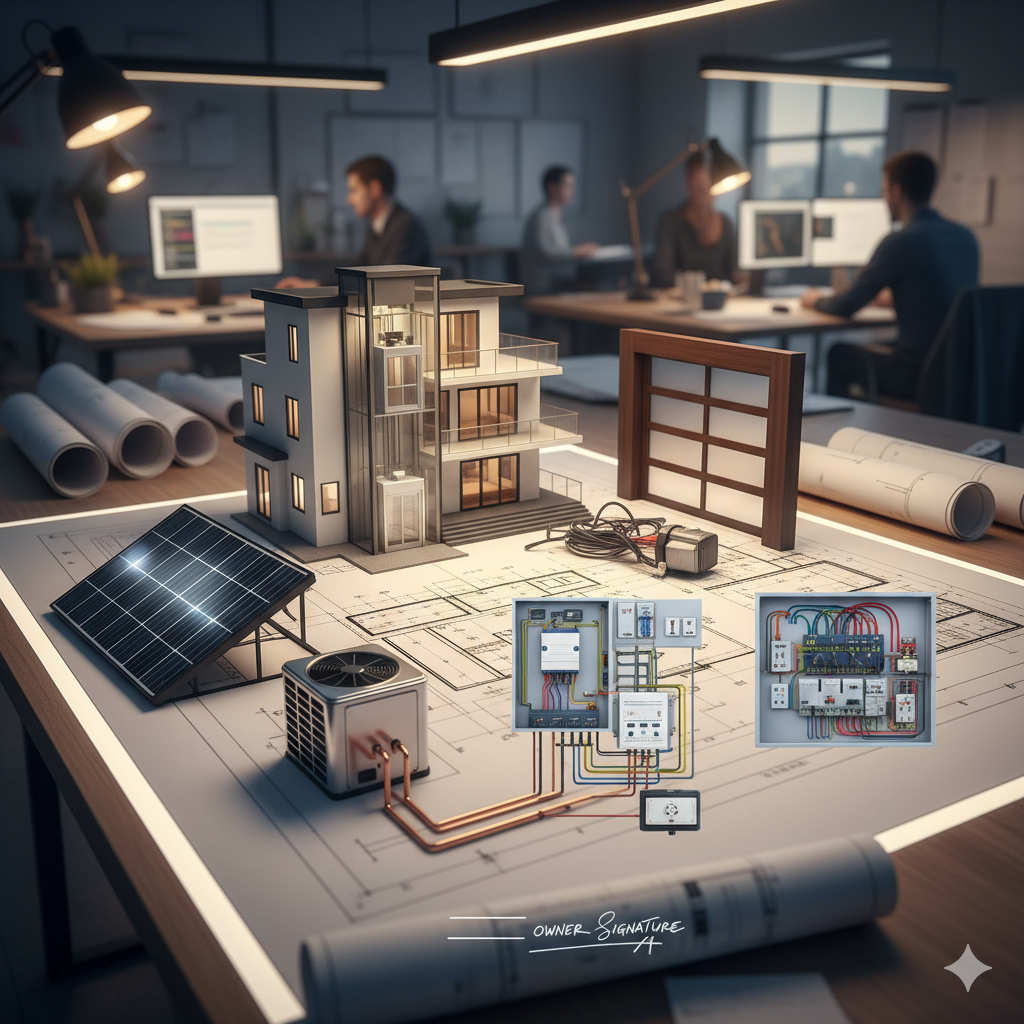
Residential cost risk often hides in “small” line items that are actually big-ticket components.
Item | Typical Client Question | What We Do In The Estimate |
Residential Elevator | How much does a residential elevator cost? How much do residential elevators cost? How much do residential lifts cost? | Identify type (shafted, shaft-less, hydraulic, traction), floors served, finishes, and include equipment + structural modifications + electrical + service clearances. |
Garage Door | How much does a residential garage door cost? | Separate basic steel, insulated, carriage-style, automated systems and include hardware, install labor, and opener systems. |
AC / HVAC | Residential AC compressor replacement cost | Clarify whether it’s a new system vs replacement, SEER rating, refrigerant type, and labor + commissioning cost. |
Solar | How much solar panels cost residential homes in Minnesota? | Consider climate, orientation, utility program, and include structure support, wiring, inverter, and integration to panel. |
Electrical Jobs | How to estimate residential electrical work? How to estimate residential electrical jobs? Does a residential electrician have a customer sign the estimate? | Break down circuits, fixture counts, panel size, rough-in vs trim, and specify assumptions clearly for owner sign-off. |
These are not side notes. In Residential Estimating Services, they can be the difference between a budget that holds and a project that collapses at MEP stage.
There is a growing range of residential cost estimating software and residential construction estimating software. These tools are valuable, but they need expert inputs.
Software Type | Example Use | Our Perspective At C.C.E |
Residential Cost Estimator Apps | Quick project budgeting and “what-if” checks | Good for rough planning, but not enough for contract-level estimates |
Residential Building Estimating Software | Quantities, assemblies, material lists | Powerful when driven by detailed drawings and realistic productivity assumptions |
Residential Construction Cost Estimator | Online calculators by zip code | Useful to cross-check order of magnitude, but we never rely on them alone |
Residential Estimating Software | Full estimating suites used by contractors | If you have one, we can format our outputs so that you can easily import and track them |
C.C.E is not a software vendor. We are a service provider that knows how to use the right tools and data to create reliable residential construction cost estimating, especially for owners, builders, and investors who don’t have full-time estimating departments.
You included keywords like California residential estimating services and residential estimating services California. Regions like California have their own cost realities:
Region | Key Considerations In Residential Estimating |
California | Seismic design, wildfires, energy codes, premium labor rates, strict permitting |
Pearl States & Cities (USA) | Variable labor, weather patterns, local codes, material supply routes |
UK | Compact sites, party walls, planning constraints, U-values |
Canada | Insulation standards, snow load, foundation design in freeze-thaw conditions |
Our reliable residential estimating services are built with these regional cost and code differences in mind. The same 2,000 sq ft home will not cost the same in Minnesota as it does in Southern California or London.
You included important questions like:
While we don’t give legal or financial advice, we know that closing costs, fees, and soft costs frequently catch owners off guard.
Cost Type | Example Items | Why It Matters In The Estimate |
Closing Costs | Title, attorney, lender fees, transfer taxes | Affects how much of your budget remains for actual construction |
Soft Costs | Design fees, surveys, engineering, permits | Can easily reach 10–20% of total project cost if ignored |
Pre-Construction | Soil tests, inspections, temporary utilities | Often not included in simple “build cost per square foot” numbers |
Contingency | Design changes, scope creep, unknown conditions | Necessary to keep the project alive when the unexpected happens |
Our Residential Estimating Services help owners and developers understand what portion of their total budget is actually available for construction vs fees, permits, and professional services.
Residential work is not only “a single house.” Different industries and property types still fall under the residential cost umbrella, and each one needs a different way of estimating.
At Construction Cost Estimation Service (C.C.E), we adjust our Residential Estimating Services to match the reality of each sector.
Residential Segment | Typical Projects | How Our Estimate Helps |
Single-Family Homes | Custom homes, spec homes, rebuilds, extensions | Clear total build cost, room-by-room and system-by-system cost view before you commit to a contractor |
Multi-Family Residential | Duplexes, triplexes, townhomes, small apartment blocks | Unit-based cost comparison, shared MEP and circulation cost, support for lenders and investors |
High-End & Luxury Homes | Homes with elevators, pools, smart systems, premium finishes | Detailed breakdown of premium items so owners see exactly where the money goes and what upgrades truly cost |
Renovations & Remodels | Kitchen, bathroom, basement, attic, additions, whole-house remodels | Strong focus on demolition, tie-in work, unknown conditions, and realistic contingency to avoid budget shocks |
ADUs & Secondary Units | Backyard homes, garage conversions, guest houses | Cost comparison between different build options and finish levels to see what is truly worth it |
Some users are not owners but work inside the residential industry. They still need strong, reliable estimates.
User Type | Role In Residential Industry | What They Gain From C.C.E Estimates |
Small Residential Contractors | Build new homes, remodels, additions | Professional estimate documents that help them price jobs, win bids, and protect profit margins |
Design-Build Firms | Offer both design and construction for residential projects | Early-stage cost checks during design, helping them keep the project inside the client’s budget |
Residential Developers | Plan small communities, townhouse blocks, or multi-unit projects | Support for feasibility, pro forma, loan applications, and phasing decisions |
Residential Electricians & MEP Trades | Provide electrical, HVAC, plumbing for homes | Line-by-line quantities and cost structure for wiring, panels, fixtures, systems, and labor |
Real Estate And Property Advisors | Help buyers and investors evaluate properties and upgrades | A clear view of likely renovation or upgrade cost to support purchase decisions |
Every region has its own construction rules, climate needs, and cost patterns. Our Residential Estimating Services focus on the USA, UK, and Canada, including Pearl states and cities.
Region | Residential Reality | Estimating Approach We Use |
United States (Pearl States & Cities) | Wide range of climates, labor rates, and permitting rules | Use local cost data, zip-based adjustments, and region-specific construction practices |
California & High-Regulation Areas | Strong seismic, energy, and fire code requirements | Add cost impact for structural detailing, insulation, fire-rated assemblies, and inspections |
United Kingdom | Tight plots, party walls, energy performance targets, planning constraints | Structure cost around U-values, layout restrictions, and tight access logistics |
Canada | Harsh winters, snow loads, freeze-thaw foundation needs | Lift structure, envelope, and mechanical assumptions to meet climate and performance requirements |
Residential projects often touch other industries that are not “pure housing” but still closely linked to homes and living spaces.
Connected Industry | Example Projects | How Residential Estimating Plays A Role |
Small Home-Based Healthcare | Clinics or therapy rooms inside homes, converted spaces | Balance between residential comfort and basic healthcare fit-out cost |
Short-Term Rental Properties | Airbnb-style units, serviced apartments | Estimating durable finishes, frequent-use fixtures, and higher service loads |
Senior Living / Assisted Living (Light Care) | Small care homes or adapted houses | Costing for accessibility changes, lifts, grab rails, wider doors, safe bathrooms |
Home Office And Live-Work Spaces | Converted rooms, backyard studios, small work areas | Understand cost of acoustic performance, electrical upgrades, data, and comfort systems |
Solar And Energy Upgrades | Residential solar systems, HVAC upgrades, insulation packages | Model long-term impact vs upfront cost to help owners decide which upgrades justify the spend |
Instead of bullets, here is a simple view of what each industry really needs from Residential Estimating Services and how C.C.E responds.
Industry Need | Common Question | C.C.E Response In The Estimate |
Budget Safety | “Can I complete this project inside my budget without getting stuck in the middle?” | We provide full cost breakdowns, highlight risk areas, and show where allowances should be higher. |
Timeline And Cash Flow | “How does cost spread across early, mid, and late stages of the project?” | We align cost groups with typical construction phases so owners and builders can plan cash flow. |
Upgrade Clarity | “If I add an elevator, higher-grade windows, or better HVAC, how much extra will it be?” | We show base cost vs upgraded cost so the decision is simple and transparent. |
Bank And Investor Confidence | “Can I show these numbers to my lender or partner?” | Estimates are structured, explainable, and ready to support meetings with banks, partners, or advisors. |
Regional Fit | “Does this estimate reflect my local labor, material, and code reality?” | We adjust for regional cost patterns in the USA, UK, and Canada, especially Pearl states and cities. |
Here is how we typically work with homeowners, builders, and investors:
Step | What You Provide | What C.C.E Delivers |
1. Intake | Drawings, sketches, scope description, location | Confirmation of understanding + scope of estimating work |
2. Document Review | Plans, specs, schedules, photos if available | Clarification questions + risk highlights |
3. Quantity Takeoff | No effort from your side | Detailed measurement of all key building components |
4. Pricing Phase | Optional input on preferred materials/brands | Cost breakdown with clear unit rates and assumptions |
5. Review Call | Your questions on line items and options | Clarifications, alternates, and budget-optimization advice |
6. Final Estimate | Your confirmation of scope | A formal, structured residential cost estimate you can use for bidding, financing, or internal decision-making |
Some projects include both residential units and commercial components (e.g., ground floor retail with apartments above). In those cases, we combine our Residential Estimating Services with our commercial estimating services expertise to split:
This helps with:
Need | How Our Dual-Expertise Helps |
Bank / Lender Requirements | Separate residential and commercial cost lines |
Pro Forma Modeling | Understand returns from each component |
Phased Construction | Determine what can be built now vs later |
Residential Estimating Services are professional services that turn your home design, remodel plan, or multi-unit concept into a structured cost breakdown. These services are for homeowners, small developers, residential contractors, and investors who want to know what a project will really cost before they commit to contracts or financing. At C.C.E, we serve clients in the USA, UK, and Canada, from first-time home builders to experienced property developers. We help you understand where the money goes structure, finishes, MEP, sitework so you can decide whether to move forward, adjust scope, or phase the work.
The residential construction cost estimator tool or per square foot calculator is good for quick ballpark figures, but it cannot read your actual drawings or understand your design decisions. It doesn’t know that you chose a complex roof, large glazed areas, high-end kitchen, or a residential elevator. A professional estimate from C.C.E is based on your actual plans, your location, and your specifications. We measure real quantities, apply real rates, and explain our assumptions. That makes the result defensible and practical, not just a generic number.
Yes. We provide California residential estimating services, along with estimates for other high-cost regions in the USA, and we account for seismic requirements, energy codes, high labor rates, and complex permitting environments. The idea is not to scare you, but to show you realistic cost expectations so you can approach banks, partners, and contractors with serious numbers that reflect your local market.
Absolutely. Items like residential elevator cost, how much do residential elevators cost, how much do residential lifts cost, solar panel installations, and advanced HVAC systems are included in our line-by-line breakdown when they are part of the design. We itemize the equipment, structural implications, electrical connections, and installation labor associated with these systems. This gives you a clear understanding of how much these upgrades contribute to your total project cost and whether they fit within your budget.
When clients ask how to estimate residential electrical work or how to estimate residential electrical jobs, they often focus only on fixtures and outlets. We go beyond that. We count circuits, panel capacities, wiring runs, specialty loads (EV chargers, hot tubs, elevators), and code-required items. We also respect real productivity rates for electricians and other trades. That way, when a residential electrician presents an estimate and asks for a customer signature, it’s easier for both parties to see whether the numbers align with a professional, third-party cost breakdown.
Indirectly, yes. While we don’t replace your financial advisor or lender, a clear, detailed construction estimate from C.C.E supports your discussions with banks and investors. When you need to understand how to estimate closing costs on a residential property or wonder if a residential lease requires estimated closing costs, our estimate won’t list legal fees, but it will clearly show construction cost vs non-construction cost portions. That clarity helps you and your advisors decide how much funding is needed and how much buffer should be included.
Accuracy depends on the level of detail in your drawings and how many selections are fixed vs pending. For well-documented projects, our estimates can align closely with final costs, especially when the project is managed according to the assumptions we outline. For conceptual designs, we clearly mark items as assumptions or allowances. Our goal is not to promise a perfect number, but to provide a transparent, structured cost model that you can refine as design progresses.
Both. Many of our clients are contractors and builders who need reliable residential estimating services to prepare bids, compare subcontractor numbers, or manage pipelines. But we also work directly with homeowners and small investors who want a neutral, professional view of their potential build or renovation cost. In those cases, we take extra time to explain the structure of the estimate so non-technical clients can make confident decisions.
We use a combination of residential construction estimating software, databases, and manual review. Software helps us speed up takeoff and ensure consistency, but human expertise is what catches missing items, unrealistic assumptions, and construction practicalities that software does not understand. Our process is a blend of technology plus estimator judgment, which is key for complex or custom residential work.
To get started, you simply share your drawings, basic scope, location, and any budget targets you have in mind. We review the information and propose an estimating scope that fits your needs—whether that’s a full pre-construction estimate, a second opinion on a contractor bid, or an option comparison. Once agreed, we perform the takeoff, build the estimate, and walk you through the results. You can then use this estimate to negotiate with contractors, seek financing, or refine your design.
OUR SERVICES
Contact us today to get started on your construction projects and experience the difference of working with Construct Estimates.
Get notified about new articles