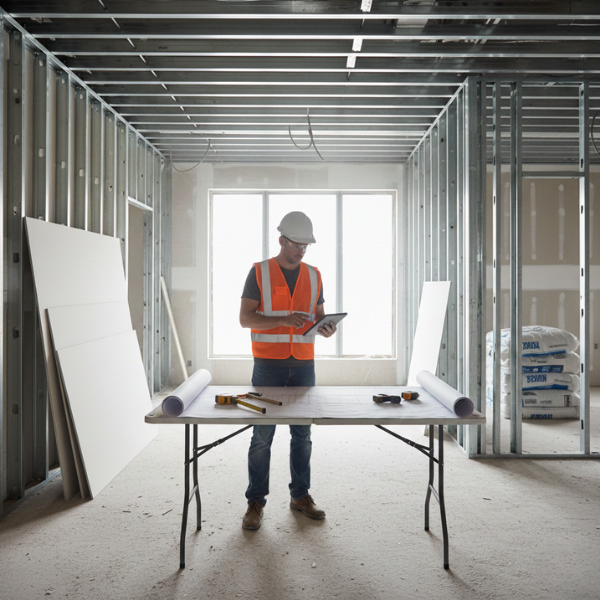
The drywall takeoff is the process of reading your plans and calculating exactly how much drywall, mud, tape, and related materials you need for a project.
Drywall looks simple on site, but on paper it is one of the easiest trades to miscount. If your drywall takeoff is wrong, you feel it everywhere: wrong material orders, extra trips, confused crews, and bids that do not match the final cost. At Construction Cost Estimation Service (C.C.E), we treat drywall takeoff services as a serious technical step inside your wider construction cost estimation services, not a quick side note.
We work with contractors, drywall subs, builders, and GCs across the USA, UK, and Canada, including Pearl states and major cities. Our role is to turn your drawings into clear drywall quantities that you can price, explain, and defend.
To give you a clear, measurable quantity breakdown that protects your bid, your budget, and your reputation.
The drywall takeoff is the process of reading your drawings and measuring all the areas where drywall will be installed. The goal is to calculate the correct amount of sheets, mud, tape, beads, and related materials before you step on site. When the drywall takeoff is done properly, you know how much board is needed on each level, how many joints and corners exist, and which areas need special treatment like fire rating or moisture resistance.
A weak drywall takeoff is just a guess on total square footage. A strong drywall takeoff is a structured breakdown by wall type, ceiling area, and location. That structure lets you build a better drywall estimate and control your drywall cost per square foot instead of chasing problems later.
Element In Scope | What We Measure And Classify | How It Helps Your Estimate |
Walls And Partitions | Net wall surface area, both faces, openings, height changes. | You get accurate sheet counts tied to real wall conditions. |
Ceilings And Soffits | Flat ceilings, bulkheads, drops, hard-lid areas. | You see the true drywall area above your head, not just the floor area. |
Board Types | Standard, fire-rated, moisture-resistant, acoustic boards. | You can apply different drywall costs for each system. |
Finishing Materials | Mud, tape, beads, trims based on joints and corners. | A built-in drywall compound estimator and drywall mud estimator. |
Special Zones | Shafts, stair cores, shafts, service rooms, feature walls. | High-risk spaces are highlighted instead of buried in totals. |
Repair And Patch Areas | Local patches, partial replacements, ceiling cuts. | Separate drywall repair estimates that do not mix with new work. |
This table keeps the drywall takeoff transparent. You can see exactly where each quantity came from and how it fits into the wider construction cost estimation services.
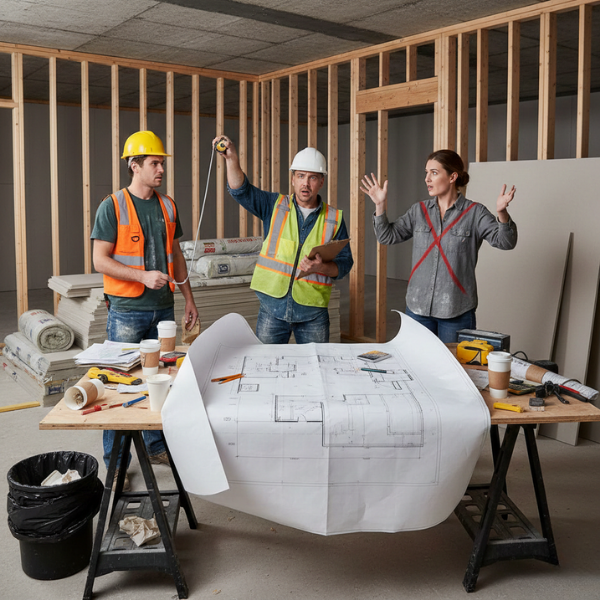
Once the quantities are correct, the next question is labor. Contractors often ask for a clean estimate for drywall installation so they can understand the full cost, not just the board and mud. The takeoff gives you measured wall and ceiling areas; you then apply your crew rates, production speeds, and job conditions on top of those numbers. This is also where people ask how much does it cost to do drywall on a complete floor, basement, or renovation. With a structured takeoff, you can test different hourly rates and crew sizes without changing the base quantities. It becomes far easier to adjust your drywall installation cost when schedules tighten or access gets worse, because you are working from a solid measured starting point, not a loose square-foot guess.
Drywall work changes with climate, code, and building type. That is why we pay attention to where your project is located. For drywall takeoff services California, we see more complex structures, tighter codes, and a mix of residential, commercial, and seismic considerations. For drywall takeoff services Florida, humidity, wind events, and coastal environments shape how wall and ceiling systems are designed. Drywall takeoff services Georgia often involve fast-growing commercial and multi-family projects, while drywall takeoff services Texas cover large footprints, warehouses, and high-volume residential developments.
For each region, the core goal stays the same. We give you clean drywall quantities that can plug into local material prices and labor rates. That way your drywall takeoff supports reliable construction cost estimation services instead of forcing you to guess from a national average.

The process starts when you send your plans, including floor plans, reflected ceiling plans, wall types, and interior elevations if available. We study the drawings to understand how the building is divided, what each wall type means, and what finish levels are expected. Then we use professional drywall takeoff software to trace the walls and ceilings, being careful with height changes, dropped ceilings, and transitions between spaces.
Once the areas are measured, we convert square footage into sheet counts based on board sizes and practical waste factors. We then apply our drywall compound estimator and drywall mud estimator logic to calculate mud, tape, beads, and other accessories based on the number of joints and corners. At the end, you receive a drywall takeoff that is organized by floor, area, and wall type, ready to use as a base for your drywall estimate.

Project Type | Typical Drywall Scope | Why Estimating Accuracy Matters |
Single Homes And Townhomes | Interior walls, ceilings, garages, basements. | Small errors per unit multiply across many houses. |
Multi-Family Buildings | Repeated units, corridors, lobbies, amenity spaces. | One miscount repeats on every floor and unit. |
Offices And Fit-Outs | Partitions, meeting rooms, ceilings, bulkheads. | Tenant layouts shift; good numbers help control change impact. |
Hotels And Hospitality | Guest rooms, corridors, public areas, service zones. | Many identical rooms require tight control on drywall cost. |
Healthcare And Institutional | Complex partitions, service-heavy zones, cleanable surfaces. | High coordination; missing board or finishes leads to rework. |
This makes it clear that proper drywall takeoff is not a luxury. It is a basic control tool for any project where drywall is more than a few sheets in a garage.
Your drywall cost per square foot depends on your local market, your crews, and your suppliers, but none of that works if the quantities are wrong. With a solid drywall takeoff, you can assign different labor and material rates to each wall type and space. A simple corridor partition does not cost the same as a high, complex shaft wall, and a small drywall repair does not behave like brand new installation on open framing.
Drywall repair estimates are especially sensitive. A small patch in a busy office or finished home may require protection, careful finishing, and return visits. Our drywall takeoff separates repair and patch areas, so you can explain to your client why drywall repair cost looks higher than they expected from the size of the damage alone.
Drywall lives on top of framing. That means your lumber layout directly affects your drywall quantities, your board waste, and your drywall installation cost. When framing is heavy with corners, offsets, and backing, you do not just use more studs. You also use more drywall sheets, more cuts, and more finishing time.
For that reason, many clients pair drywall takeoff with our Lumber Takeoff Services. You can reference our Lumber Takeoff Services page here:
When both structural wood and drywall are taken off together, you can see how the frame and board interact. Backing for cabinets, handrails, and mounted equipment is not guessed; it is identified from drawings and counted. That connection produces more realistic drywall quantities and leads to better construction cost estimation services across the whole project.
Residential drywall work and commercial drywall work feel different on site, but both need structured takeoffs. In residential projects, the drywall estimator must keep a close eye on repeated plans like townhomes, duplexes, and multi-family buildings. A small error in drywall area per unit can turn into a major problem when the same mistake repeats across dozens of homes.
In commercial projects like offices, hospitals, schools, hotels, and mixed-use buildings, the issue is less repetition and more complexity. There are shafts, service risers, tall spaces, and specialized wall systems. Our drywall takeoff services adapt to both worlds. The method stays the same: read the drawings like an experienced builder, measure carefully, and document clearly, so you can price both residential and commercial work with the same level of confidence.
At C.C.E, drywall is one part of a bigger picture. Our drywall takeoff services sit alongside other trades inside complete construction cost estimation services. When drywall quantities are broken down clearly, they can be linked with interior finishes, paint, ceilings, and even mechanical trades where service penetrations and access points can drive rework.
Clear quantities let you test options before you commit to a design. You can compare different board types or finish levels and see what each choice does to your drywall cost and drywall installation cost. This process gives owners, GCs, and subs better control over their budgets and reduces the risk of last-minute surprises in the field.
Most owners start with a simple question: how much does drywall cost for my project? The honest answer is that the cost of drywall depends on the sheet type, thickness, and location, not just the size of the room. A solid takeoff gives you the exact board count, so you can move from guesses to real numbers.
When people search how much a sheet of drywall costs or how much a sheet of drywall costs, they usually only see store prices. On a real job, that sheet also needs moving, cutting, fastening, and finishing. With a detailed drywall takeoff, you can show exactly how many sheets each area needs and then tie those sheets to labor and overhead, instead of pretending the material price alone tells the whole story.
Once the quantities are correct, the next question is labor. Contractors often ask for a clean estimate for drywall installation so they can understand the full cost, not just the board and mud. The takeoff gives you measured wall and ceiling areas; you then apply your crew rates, production speeds, and job conditions on top of those numbers.
This is also where people ask how much does it cost to do drywall on a complete floor, basement, or renovation. With a structured takeoff, you can test different hourly rates and crew sizes without changing the base quantities. It becomes far easier to adjust your drywall installation cost when schedules tighten or access gets worse, because you are working from a solid measured starting point, not a loose square-foot guess.
Many newer contractors and small builders want to improve their own pricing skills. They search how to estimate drywall, how to estimate drywall work, or even how to estimate a drywall job when they are staring at a fresh set of plans. The first step is always the same: build a clear drywall takeoff that separates walls and ceilings, different board types, and special conditions like shafts and wet areas. Once the quantities are clean, the estimating decisions become much simpler.
Repair work is another common pain point. People want to know how much drywall repair costs, or more specifically how to estimate drywall repair cost for cracks, holes, and water damage. A good repair estimate looks at more than damaged square footage. It considers access, height, room use, protection, and matching texture. When your takeoff and notes capture those details up front, your drywall repair estimates feel fair to clients and still protect your margin.
When you send us your drawings, you are not buying a fast square-foot guess. You are asking an experienced estimator to sit with your plans and treat your drywall scope as if it were their own project. We read the details, measure with care, and structure the results so they make sense to anyone familiar with real jobsite conditions.
You receive drywall quantities that are ready to use in your estimate, compatible with your local pricing, and easy to adjust when design changes. You can link these numbers with framing through our Lumber Takeoff Services and fold them into full construction cost estimation services for projects across the USA, UK, and Canada. Instead of worrying about whether someone miscounted a corridor or forgot a ceiling, you can focus on pricing, scheduling, and delivering the work.
Drywall takeoff services mean we look at your drawings and work out exactly how much drywall and related materials your project needs. We measure all walls and ceilings, convert those areas into sheet counts, and then calculate how much mud, tape, beads, and accessories are required. This turns a complicated set of plans into a clear, organized list of quantities that you can use to set your drywall cost and build a reliable estimate.
We start by gathering your floor plans, wall type schedules, ceiling plans, and interior elevations. Using professional drywall takeoff software, we trace each wall and ceiling area to find the total square footage for every type of partition and surface. We then break that down into sheet counts and finishing materials with realistic waste factors. Finally, we present those numbers in a structured format, so you can see which areas belong to each level, room, or wall type.
Yes, we regularly support projects with drywall takeoff services California, drywall takeoff services Florida, drywall takeoff services Georgia, and drywall takeoff services Texas. Each of these markets has its own patterns, building types, and cost challenges. Our job is to give you accurate quantities that reflect the design, so you can pair them with your local labor and material rates. That keeps your drywall estimate grounded in your real market, not generic national averages.
The drywall takeoff gives you the real numbers behind each surface rather than one lump total. When you know how many square feet of standard walls, fire-rated walls, and special walls are present, you can assign different drywall cost per square foot to each category. Ceiling work, tall partitions, and detailed soffits often demand higher labor and material allowances. Instead of treating the entire project as one rate, the takeoff lets you price each part of the building properly.
We do both. For new projects, we focus on full wall and ceiling systems. For existing buildings, we can help with drywall repair estimates when you provide information about the damage and location. Repairs often require extra time for access, protection, and finishing. A proper drywall repair estimate must consider height, room type, and match to existing surfaces, not just patch size. Our takeoff structure helps you explain to clients why repair prices are based on effort, not just square inches.
Framing and drywall are connected from the very first layout. If the framing drawings change, the drywall scope changes too. When we combine drywall takeoff with our Lumber Takeoff Services, we align studs, blocking, and backing with board usage. This prevents situations where drywall installers discover missing backing or unexpected corners in the field. That integrated approach leads to a more accurate estimate and cleaner coordination between trades, especially in multi-family and commercial work.
Many clients use our takeoff files as a learning tool. You can see how walls and ceilings are grouped, how sheet counts are derived from square footage, and how finishing materials are tied to joint lengths and corners. While we are not a full training program, the structure of our takeoffs gives you a clear picture of how an experienced drywall estimator thinks. Over time, that can help you improve your own internal estimating practices.
No, we work with a range of clients. Some are large contractors and developers who need detailed support for major jobs. Others are smaller drywall contractors or builders who want to back up their own estimate with a second set of eyes. The common link is not company size but the desire to base drywall cost and drywall installation cost on solid measurements instead of rough guesses. We tailor our deliverables to the level of detail that suits your project and workflow.
Accuracy always depends on the quality and stability of the drawings, but our method is built to be careful and traceable. We use digital drywall takeoff software, we read the drawings as if we were planning the build, and we document assumptions clearly. Field conditions and last-minute changes can always create differences, but a structured takeoff dramatically reduces unexpected gaps in material and labor. It puts you in a stronger position to manage changes when they do appear.
You can always do a quick drywall takeoff yourself, but quick methods often skip important details. At C.C.E, drywall takeoff services are handled by estimators who specialize in reading plans, controlling quantities, and supporting full construction cost estimation services. We have the time, tools, and focus to measure properly and structure your numbers so they stand up under scrutiny. That gives you more confidence when you submit a bid, negotiate with a client, or manage a tight project budget.
OUR SERVICES
Contact us today to get started on your construction projects and experience the difference of working with Construct Estimates.
Get notified about new articles