If Your Concrete Numbers Are Wrong, The Job Punishes You.
Every contractor knows this: one bad concrete estimate can turn a decent project into a painful one. Too low, and the pour stops mid-way, trucks wait, crews stand idle, and you pay rush charges just to finish. Too high, and the job still finishes, but your profit quietly disappears into wasted yards and extra labor.
The Construction Cost Estimation Service (C.C.E), our Concrete Estimating Services are built to stop exactly that. We read your drawings the way a site crew builds them and give you concrete quantities and costs you can defend on site, in the bid room, and in your accounts across the USA, UK, and Canada, including fast-moving Pearl states and cities.
To give you a clear, measurable quantity breakdown that protects your bid, your budget, and your reputation.
The concrete estimator’s job is not to copy dimensions from a plan. They separate each structural element, understand how it will actually be formed and poured, and then convert it into cubic yards that make sense in the field. They look at details many people skip: thickness transitions, slope, steps, haunches, openings, and construction joints. They also think in pours and sequences, not just in total volume, so the estimate fits how the job will really run. This is the difference between a neat spreadsheet and a number that the foreman can trust.
Element Type | What We Check | What You Get |
Slabs | Length, width, thickness, slopes, thickened edges, joints. | Accurate cubic yards for floors, patios, and flatwork. |
Footings | Width, depth, length, steps, bearing conditions. | Reliable volume for foundations and grade beams. |
Walls | Height, thickness, length, openings, pilasters. | Correct volume for basement, retaining, and shear walls. |
Stairs & Ramps | Riser/tread profiles, landings, slopes, variable thickness. | Realistic volumes for access elements and circulation. |
Site Concrete | Paths, drives, aprons, curbs, exterior slabs. | Clear quantities for all external concrete scope. |
We do not treat everything as a simple rectangle. Each element is measured in context, using details from plans, sections, and notes. Then we convert the total cubic feet into yards and apply an appropriate waste factor based on complexity. This controlled process is what makes estimating concrete volume consistent across different project types.

Knowing the cubic yards is only half the job. To be useful, the estimate must answer the real-world question: “How much money will this scope need?” We build your cost using concrete supply rates, labor productivity, formwork effort, and placement method (pump, chute, buggy, etc.). We separate base cost from risk allowance, so you can see where uncertainty lives in the estimate. This kind of concrete cost estimator approach lets you adjust pricing without breaking the logic of the takeoff.
Not every project justifies a ready-mix truck. Repairs, small pads, posts, steps, and remote locations often run on bagged concrete. We convert total volume into bag counts using actual yield per bag size, not guesses. This helps contractors and owners avoid under-buying or ending up with piles of unused bags. When the volume hits a point where ready-mix is cheaper, we highlight that clearly so you can switch approaches with confidence.

Driveways and pathways look simple on a drawing but can be costly if thickness, slopes, and joints are underestimated. Our concrete driveway cost estimator style workflow includes subgrade prep, thickness, reinforcement, joint layout, and finish type. We also consider access and edging, which impact labor time and poor strategy. This gives you a single number that respects both design intent and field reality. The result: fewer “surprises” after you have already submitted your bid to the homeowner.
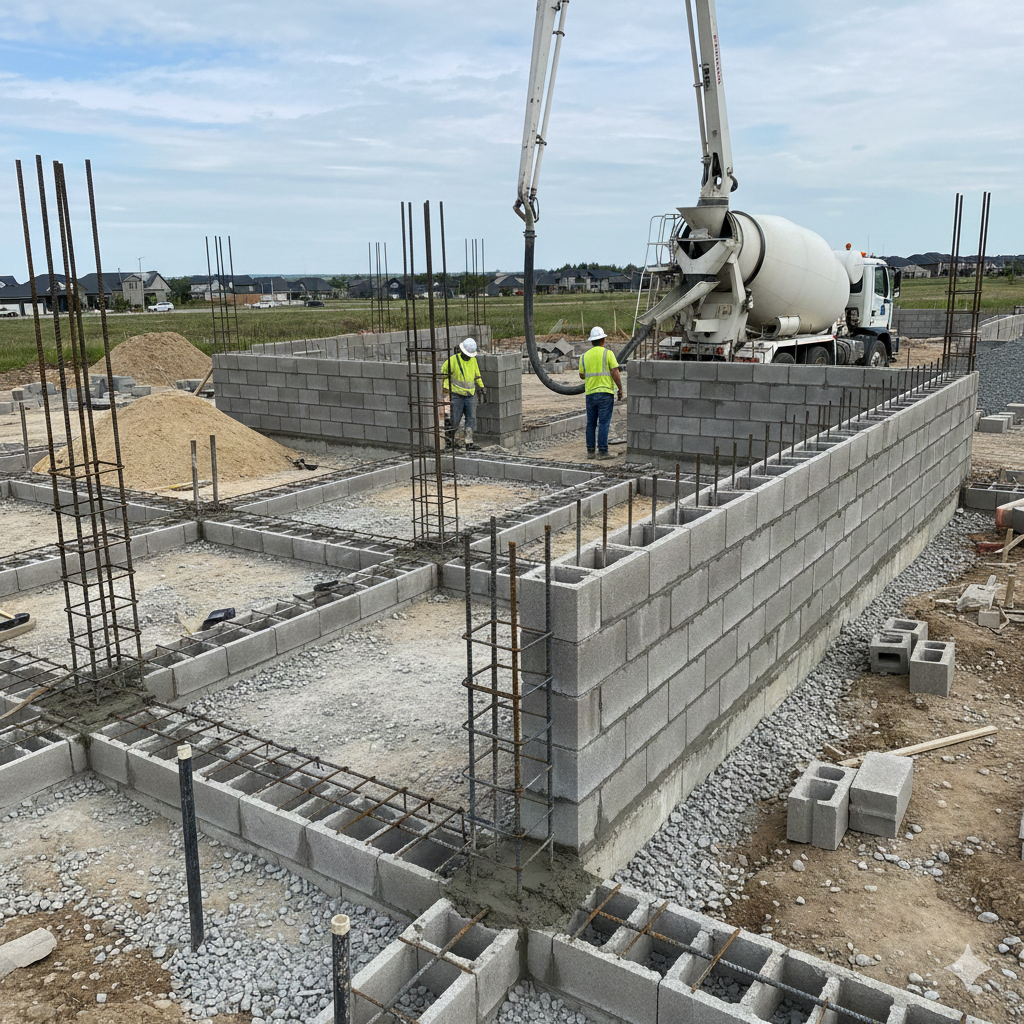
Footings, stem walls, and block walls should never be estimated in isolation. If one person estimates the footing and another estimates the wall, scope gaps and overlaps easily appear. We combine concrete footing estimator work with concrete block estimator logic where needed, so foundations and walls read as one continuous system. Openings, pilasters, stepdowns, and turn-downs are all accounted for in the same measurement story. For masonry-heavy projects, we align concrete with our dedicated Masonry Estimating Services so nothing is missed between the two trades.
Columns, pits, machine bases, heavily sloped slabs, and odd-shaped structures cannot be treated as simple rectangles. We break irregular elements into geometric components that can be measured cleanly. Each component’s volume is calculated and then recombined into a total that matches the real shape. This workflow avoids the usual “add a bit more for safety” approach that quietly destroys your margin. You get quantities that are tight enough for profit but safe enough for execution.
On many projects, the weight of the concrete is as important as the volume. Suspended slabs, existing structures, crane lifts, and temporary platforms all need accurate load information. Using a concrete weight estimator approach, we convert volume into load so structural engineers, crane operators, and site managers know what they are dealing with. This supports safer pours, better staging plans, and fewer last-minute changes.
It is particularly important in industrial, retrofit, and multi-story work, where mistakes can be extremely expensive.
Concrete prices and labor productivity shift from region to region. We do not force one “standard rate” into every estimate. Instead, we adapt our assumptions to the area: USA, UK, and Canada, with special focus on Pearl states and cities where material prices and timelines move quickly. We pay attention to local supply constraints, working patterns, and union or non-union labor, as applicable. This gives you a concrete estimate that feels grounded in your actual market, not copied from a book.
Most retaining structures, basements, and cores use both concrete and masonry. If these scopes are estimated in silos, no one owns the interfaces, and that is where cost risk hides. The C.C.E, we prefer to handle concrete and masonry as one package whenever possible. Our Concrete Estimating Services can be directly coordinated with Masonry Estimating Services, so footing volumes, block counts, grout, and bond beams line up. This integrated view helps prevent “I thought that was in your scope” disputes after you have already won the job.
You are not just buying a number; you are buying clarity. Our concrete estimates show exactly what is being poured, how much of it exists, and what it will realistically cost. They support your bids, your negotiations, and your internal decisions on risk and margin. Whether you run residential flatwork or large structural work, C.C.E gives you concrete quantities that behave properly in the real world.
Project Type | Typical Concrete Elements | Why Estimating Accuracy Matters |
Residential Homes | Slabs-on-grade, driveways, patios, steps, garage floors. | Thin margins mean even small volume mistakes can wipe out profit on smaller projects. |
Commercial Buildings | Foundations, suspended slabs, columns, beams, ramps. | Complex structures; miscalculations lead to major change orders, delays, and cost overruns. |
Industrial Facilities | Heavy-duty floors, pits, equipment bases, thick slabs. | High loads; the wrong volume or weight assumptions can damage equipment or the structure itself. |
Site & Civil Works | Walkways, curbs, retaining walls, aprons, loading areas. | Large surface areas; costs add up quickly, so precision is essential to protect the budget. |
Our concrete estimating services include a full measurement of all concrete elements from your drawings and a conversion into cubic yards, bag counts where needed, and complete cost breakdowns. We cover slabs, foundations, walls, stairs, ramps, driveways, and exterior flatwork. Along with quantities, we build labor and equipment cost, formwork effort, and controlled waste factors so you can use the estimate directly for bidding, budgeting, or cross-checking your internal numbers.
We start by splitting the project into clear elements such as slabs, footings, and walls. For each element, we measure actual dimensions, including thickness changes, slopes, and details shown in sections or notes. These volumes are added together and converted into cubic yards by dividing by twenty-seven. After that, we apply a realistic waste percentage based on project complexity, so the final number covers both design quantity and site conditions without being excessive.
Yes, we regularly estimate concrete for residential driveways, patios, steps, and small slabs. Even for smaller jobs, we treat the scope carefully by looking at thickness, reinforcement, subgrade, access, and finishing requirements. If the job is very small or in a tight location, we can use a bag concrete estimator method to tell you how many bags you will need instead of a full truck. This makes planning, purchasing, and pricing simpler for homeowners and small contractors.
To estimate bags of concrete, we first calculate the volume of the holes, pads, or repair areas. Then we divide that volume by the yield of the bag size you intend to use, such as 40kg or 80lb bags. We also include a bit of extra allowance for minor variations in hole size and spillage. This way you know how many bags to buy before you go to the supplier, and you reduce both last-minute trips and overspending on unused material.
Concrete weight estimation matters when the structure or equipment supporting the pour has a limit. On suspended floors, bridge decks, or existing structures, an incorrect weight assumption can create serious safety risks. By converting volume into weight, we help engineers, crane teams, and site managers check whether their planned pour and staging are within safe ranges. This supports safer operations and reduces the chance of structural damage or load-related failures.
We do not guess when it comes to stairs or ramps. Instead, we break them into smaller geometric shapes that match the actual design such as separate runs, landings, and edge thickening. Each part is measured and converted into volume, then combined into a total. This method is especially important where slopes, irregular layouts, or multiple landings exist, because simple “rectangle” assumptions usually understate or overstate the concrete required by a noticeable amount.
A concrete block estimator calculates the number of blocks, mortar, and grout needed for a wall, while concrete estimating focuses on foundations, cores, and any grout fills that use concrete. On many projects, these scopes are linked: the footing supports the block wall, and certain cells must be filled with grout or concrete. When we handle both areas together and connect them with our Masonry Estimating Services, you get one unified view instead of separate numbers that may not align.
Yes, we support a wide range of clients. Some are small contractors who need help estimating a few driveways or house slabs each month. Others are commercial or industrial builders handling multi-level structures or large flatwork projects. Our process adjusts to project scale, but the core principles stay the same: measure carefully, price logically, and clearly show how the numbers were built. This makes our estimates useful no matter how big or small your company is.
We tailor our estimates by adjusting labor rates, material pricing, and productivity assumptions to match the region where you are building. We consider factors such as climate, working hours, union or non-union labor, and typical supplier lead times. For Pearl states and cities, where competition and cost changes can be intense, we pay particular attention to current price levels and practical crew outputs. This ensures that the estimate feels local and usable in real tenders and negotiations.
You can measure concrete yourself, but it takes time, focus, and experience to do it accurately under pressure. A professional concrete estimating service like Construction Cost Estimation Service (C.C.E) lets you offload the most time-consuming part of preconstruction while improving accuracy. We bring a structured method, checked formulas, and experience from many projects. That means fewer missed items, fewer last-minute changes, and a clearer picture of your risk and margin before you commit to a bid or budget.
OUR SERVICES
Contact us today to get started on your construction projects and experience the difference of working with Construct Estimates.
Get notified about new articles